←
All field notes
Fleet Planning
Should Police Departments Upfit Vehicles In-House or Use a Specialized Upfitter?
Should your department build police vehicles in-house or work with a specialized upfitter? Compare staffing, cost, capacity, consistency, and real-world examples.
Guardian Fleet Safety
Public Safety Vehicle Upfitting Experts
8 min read
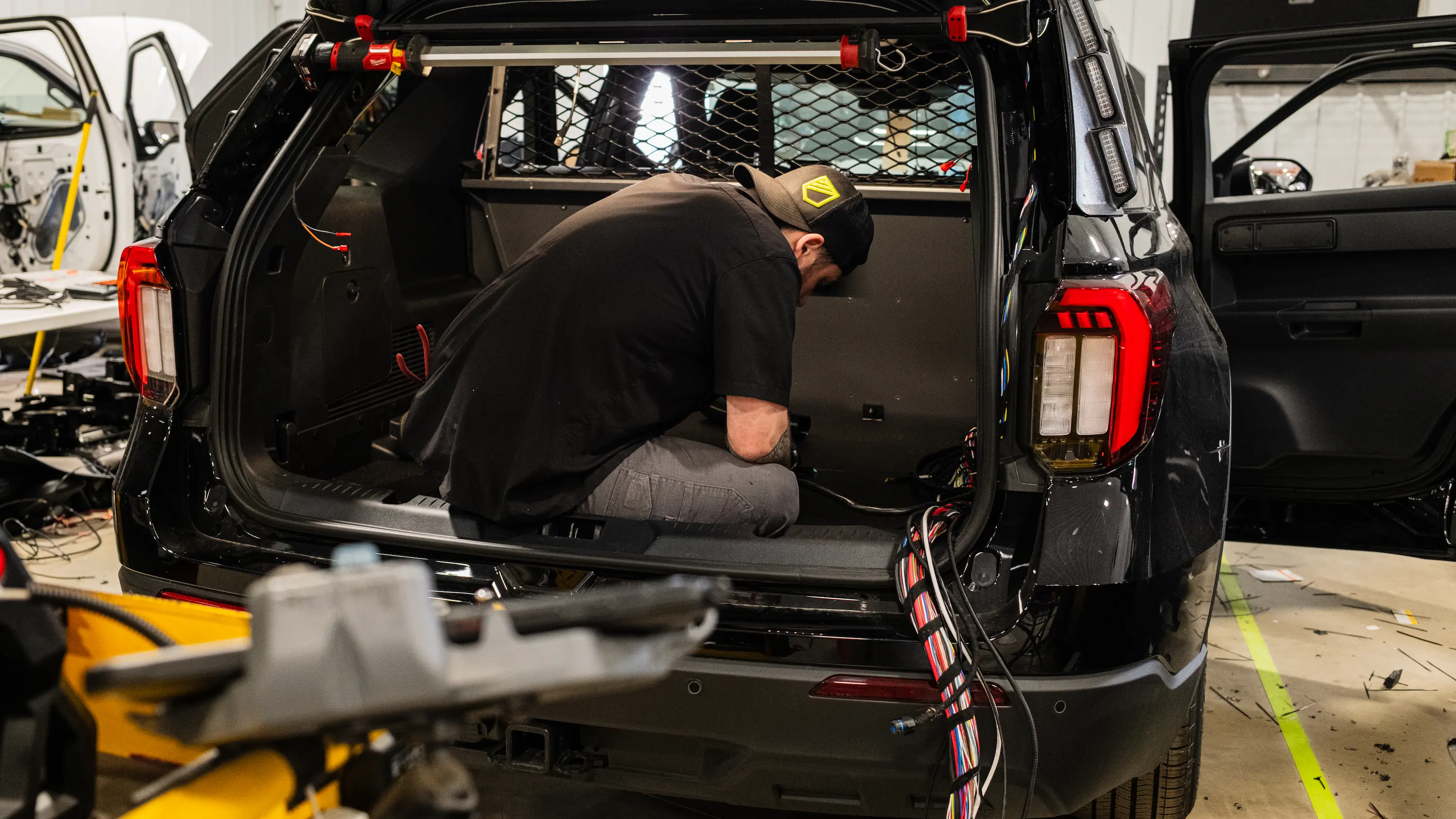
Should Police Departments Upfit Vehicles In-House or Use a Specialized Upfitter?
There’s no universal answer. Fleet size, vehicle complexity, staffing, production capacity, and long-term support all matter.
Modern police vehicles are much more than marked cars with lights and radios.
They are mobile workspaces filled with warning systems, computers, cameras, communications equipment, prisoner transport solutions, connectivity, storage, and technology officers depend on throughout every shift.
That makes one fleet decision increasingly important:
Should your department build police vehicles in-house, or partner with a specialized public-safety upfitter?
Quick Answer
There is no one-size-fits-all answer.
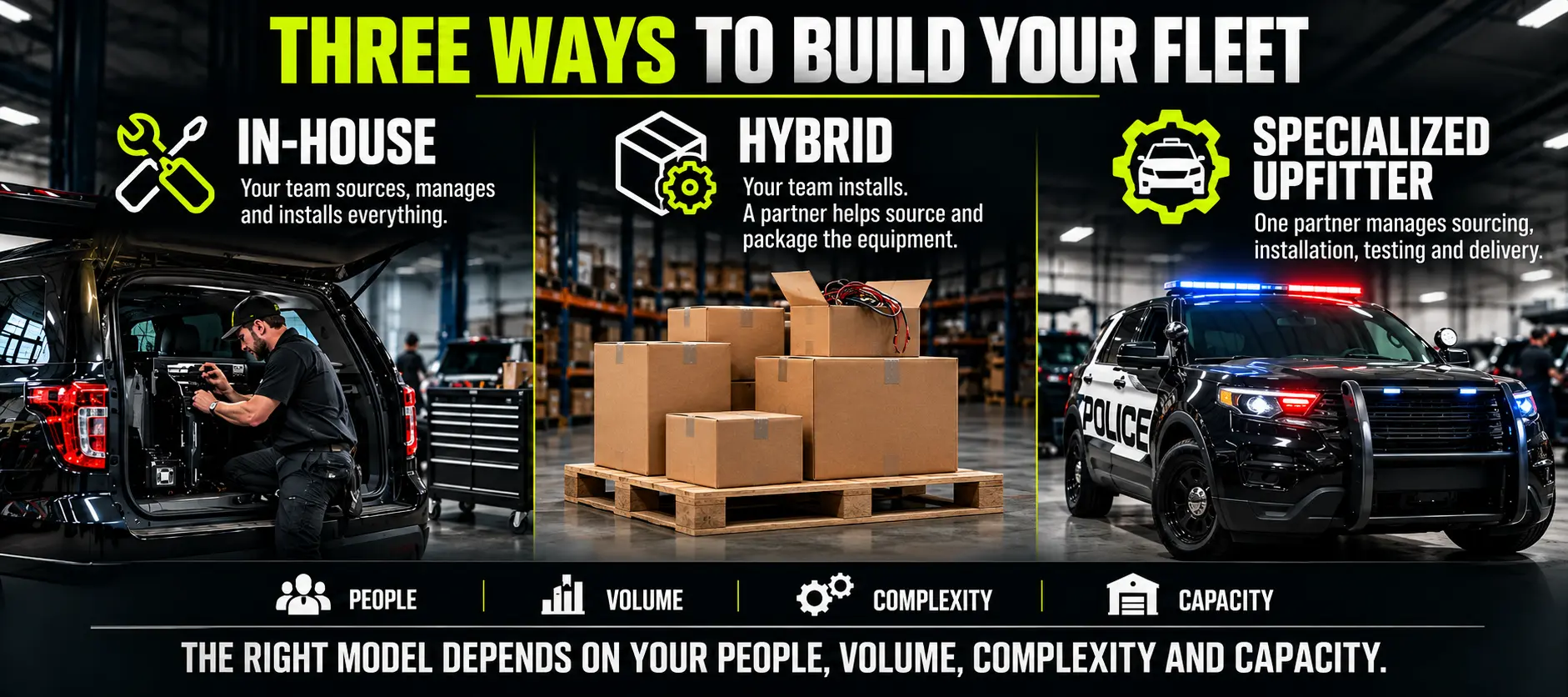
In-house upfitting can make sense for agencies with enough vehicle volume, trained technical staff, dedicated space, tooling, documentation, and production capacity.
For departments that do not want to build and maintain that infrastructure, a specialized public-safety upfitter can provide greater consistency, production capacity, technical expertise, and accountability.
The real question is not simply whether your department can build vehicles in-house.
It is whether doing so is the best use of your people, time, facility, and budget.
Below, we break down the advantages, tradeoffs, and real-world examples of each approach.
Why This Decision Matters More Than It Used To
Police vehicle upfitting has become increasingly specialized.
A modern patrol vehicle may combine emergency lighting, sirens, computers, cameras, cellular connectivity, radar, radios, prisoner transport equipment, storage, weapon mounts, and other systems inside one vehicle.
Those systems have to work together while respecting factory safety systems, vehicle electronics, equipment placement, officer ergonomics, and future service needs.
Government Fleet’s 2024 analysis of in-house versus outsourced police vehicle upfitting identified vehicle assignment, annual volume, vehicle type, labor cost, technical knowledge, and staffing capacity among the factors agencies should evaluate. Government Fleet
So the decision is about much more than installation cost.
It is also about capacity, consistency, accountability, and how your department wants to use its people and resources.
When In-House Police Vehicle Upfitting Can Make Sense
Building vehicles internally can be a good solution for the right department.
Direct Control
When the people performing the work are part of your organization, priorities can be adjusted quickly.
An internal team may be able to make small changes, complete repairs, or move a particular vehicle ahead in the schedule without coordinating with an outside company.
Familiarity With Your Fleet
A strong internal team can develop a deep understanding of how the department prefers vehicles to be configured.
Standardized console layouts, switch functions, storage locations, and equipment placement can become familiar and repeatable over time.
Existing Staff and Facilities
For agencies that already have skilled technicians, workspace, tools, and an established process, internal upfitting may be a logical extension of existing fleet operations.
This can be particularly practical for simpler vehicles that require less equipment.
High Volume Can Justify Dedicated Resources
For very large fleets, there may be enough consistent demand to justify dedicated upfitting personnel and infrastructure.
Florida Highway Patrol is a good example. Its centralized installation operation has used dedicated installation teams and preassembled components such as consoles and partitions, allowing the facility to complete roughly 12 vehicles per week. Government Fleet
At that scale, investing in a dedicated internal operation can make sense.
The Challenges of Building In-House
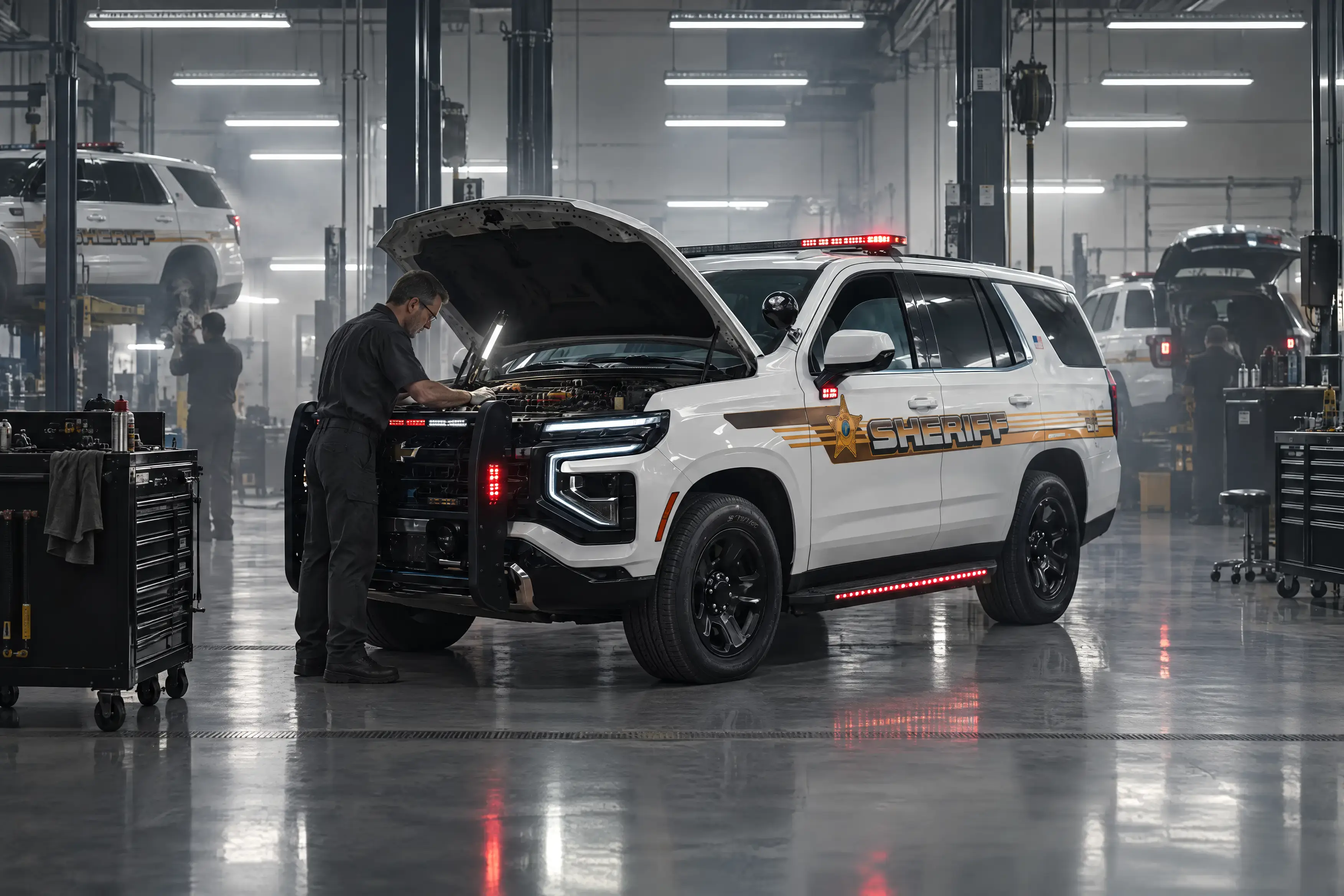
The question is not simply whether your technicians are capable of installing equipment.
It is whether the department wants to develop and maintain the entire system required to do it consistently.
Specialized Knowledge
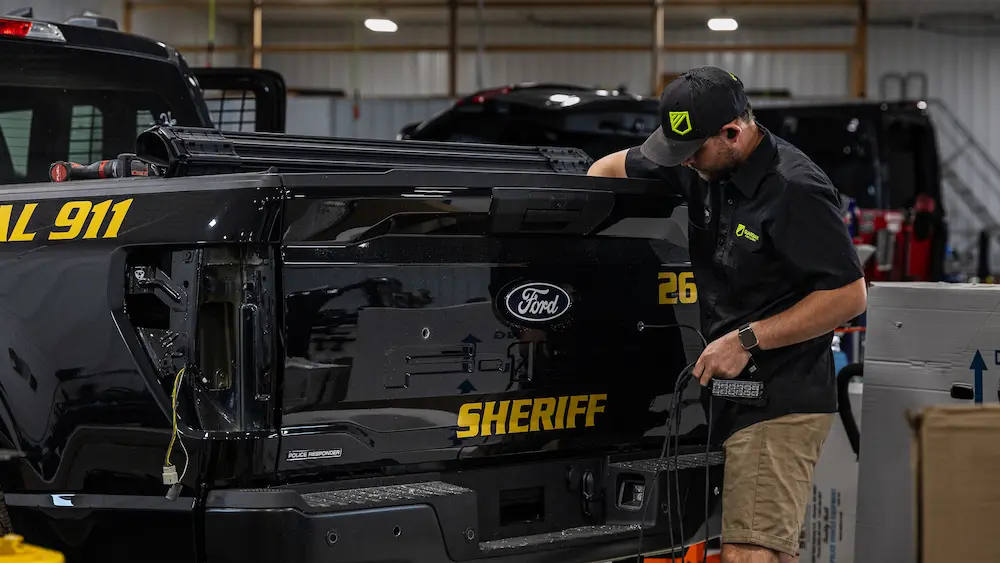
Modern police vehicles require knowledge of vehicle electronics, cameras, computers, communications equipment, emergency warning systems, OEM requirements, programming, airbag zones, and technology integration.
Building that capability internally takes experienced people, ongoing training, documentation, tools, and time.
Production Capacity
Upfitting new vehicles can compete directly with another critical responsibility: keeping the vehicles already on the road running.
Denver provides a good example.
The city generally completes lighter administrative builds internally but outsources more complex patrol vehicles. Denver receives roughly 80 to 120 vehicles during a typical budget cycle, and its fleet superintendent told Government Fleet that completing those upfits internally tied up technicians who were also needed to maintain the existing fleet. Government Fleet
Sometimes the limiting factor is not capability.
It is capacity.
Consistency
One vehicle working correctly is not the same as creating a repeatable fleet standard.
As vehicle volume grows, departments need processes that help ensure equipment placement, programming, installation quality, documentation, and operation remain consistent from one build to the next.
That consistency matters to the technicians servicing the vehicle and to the officers moving between vehicles.
Tools, Inventory, and Parts Management
An internal operation also needs more than labor.
Departments may need dedicated tools, test equipment, workspace, commonly used parts, replacement equipment, storage, documentation, and relationships with numerous manufacturers and distributors.
Those requirements can make the true cost of an internal program harder to calculate than technician hours alone.
When a Specialized Police Vehicle Upfitter Makes Sense
For many departments, outsourcing allows the agency to focus its people and facilities on the work they already do best.
Dedicated Expertise
A specialized public-safety upfitter works with police vehicles every day.
Lighting, sirens, technology, cameras, computers, communications systems, partitions, storage, graphics, and vehicle electronics are part of the same production process rather than separate projects.
Greater Production Capacity
A dedicated upfitter is built around producing vehicles.
That can be especially valuable when an agency receives multiple vehicles at once, replaces a large portion of its fleet, or needs new vehicles put into service without pulling fleet technicians away from maintenance work.
Repeatable Builds
Standardized processes allow agencies to create a fleet where vehicles operate and feel familiar from one unit to the next.
That can simplify officer use, future specifications, troubleshooting, and service.
Less Internal Coordination
A full police vehicle build can involve equipment from numerous manufacturers.
When a specialized upfitter manages the project, the department does not have to independently coordinate every component, shipment, installation, and vendor relationship.
One Point of Accountability
When one partner manages the entire build, there is a clear place to go when questions arise.
That can be easier than determining which supplier or installer is responsible for an issue involving multiple systems.
Outsourcing Has Tradeoffs Too
Choosing an outside upfitter does not automatically solve every problem.
The quality of the partner matters.
A department should understand the upfitter’s:
Production capacity
Communication process
Quality-control procedures
Service capabilities
Warranty
Delivery process
Experience with the department’s equipment and vehicle platforms
Ability to maintain consistent specifications over time
A poor external partner can create just as much frustration as an under-resourced internal operation.
That is why selecting the right partner matters as much as deciding to outsource.
Real-World Example: A Hybrid Approach
The answer does not always have to be completely in-house or completely outsourced.
Denver uses both.
Lighter administrative vehicles are generally handled internally, while more equipment-intensive patrol vehicles are outsourced. That allows internal technicians to perform work that fits their capacity while using an outside specialist when vehicle volume and complexity increase. Government Fleet
That hybrid model may make sense for many agencies.
Routine repairs, minor equipment changes, or basic vehicles can stay internal while full patrol, K9, command, or specialty builds go to a dedicated upfitter.
Building In-House Doesn’t Mean Sourcing Everything Yourself
There is another version of the hybrid model.
Some departments have the technicians, facility, and experience to complete their own installations but do not want to manage all of the purchasing and inventory behind the build.
Guardian can support those agencies too.
Tell us what the vehicle needs, and Guardian can source the equipment, organize the complete package, place it together on a pallet, and ship it to the department so the team can begin its build with the equipment ready.
That can reduce the need to:
Contact numerous manufacturers and distributors separately
Establish and manage multiple vendor accounts
Track multiple purchase orders
Receive equipment through numerous individual shipments
Store large quantities of miscellaneous inventory
Wait for one missing component before beginning a build
Government Fleet has also highlighted this type of relationship, noting that some agencies perform their own upfitting while working with an outside upfitter simply to procure components and take advantage of an established equipment supply chain. Government Fleet
Your team handles the installation. Guardian helps simplify what needs to happen before the build starts.
Questions to Ask Before Choosing In-House or Outsourced Upfitting
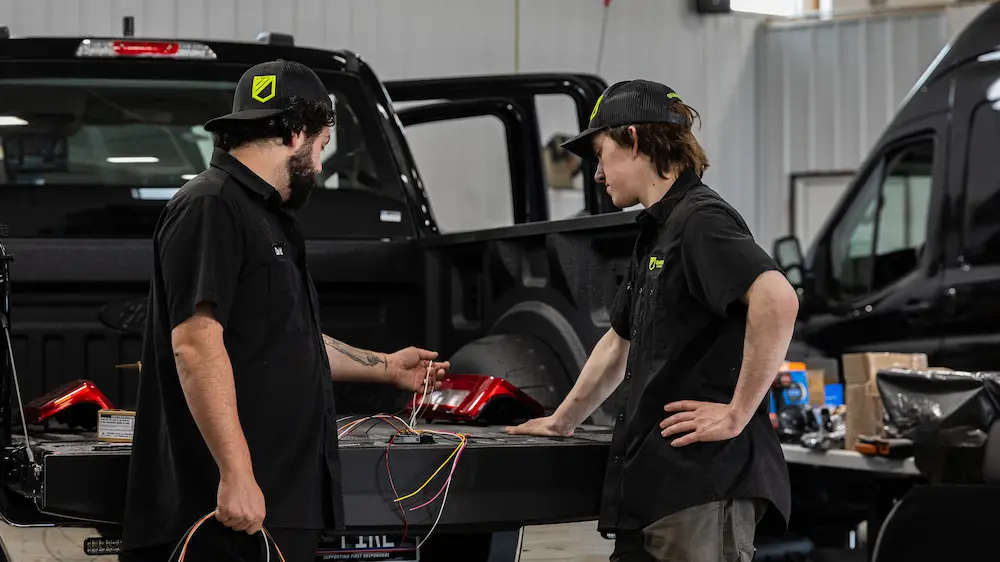
Before deciding which approach is right for your department, consider a few practical questions.
How Many Vehicles Do You Build Each Year?
A handful of simple vehicles creates a very different workload than 20, 50, or 100 fully equipped patrol units.
Also consider what happens when vehicle deliveries arrive at the same time.
How Complex Are Your Builds?
Installing basic warning equipment is different from integrating cameras, computers, connectivity, radar, advanced lighting controls, prisoner transport systems, and specialty equipment.
Complexity increases the need for specialized knowledge and repeatable processes.
Do You Have Dedicated Staff?
If the same technicians responsible for maintaining the fleet also perform new vehicle upfits, what work gets delayed while those builds are underway?
Do You Have the Space and Equipment?
Consider installation bays, storage, inventory, programming tools, test equipment, specialty tools, and room for vehicles waiting to be completed.
Can You Produce Consistent Vehicles?
Can the department document the build well enough that vehicle number 20 functions like vehicle number one?
What Happens When Volume Increases?
A grant, replacement cycle, vehicle availability, or unexpected delivery schedule can suddenly create a large production backlog.
How easily can your operation scale?
Who Owns the Problem Later?
Whether the vehicle is built internally or externally, there should be a clear process for troubleshooting, service, documentation, warranty, and accountability.
How Guardian Fits Into the Equation
For departments that decide a specialized public-safety upfitter is the right approach, Guardian focuses on reducing the work surrounding the build as much as the installation itself.
Pickup & Delivery
Guardian handles transportation so departments do not have to dedicate officers or fleet staff to moving vehicles back and forth.
Fast, Planned Production
Equipment is ordered and staged before production begins so the vehicle can be built fast once everything is ready.
A typical fully staged Guardian vehicle spends approximately 2 to 3 days in production before moving through the inspection and delivery process.
One-Stop Coordination
Guardian manages the complete upfit so the agency is not responsible for coordinating numerous installers and vendors just to finish one vehicle.
Former-Officer Account Representatives
Departments plan vehicles with Account Representatives who come from law enforcement backgrounds and understand how the vehicle and equipment will actually be used.
That helps turn officer needs into practical specifications before production begins.
Consistency Across the Fleet
Repeatable layouts, programming, documentation, and inspection processes help departments carry successful specifications from one vehicle to the next.
So Which Approach Is Right for Your Department?
There is no universal winner.
A department with sufficient volume, trained personnel, dedicated space, tooling, documentation, supply relationships, and production capacity may have a strong case for building vehicles internally.
A department that does not want to develop and maintain that infrastructure may get more value from a specialized public-safety upfitter.
And some agencies may find that the best solution is a combination of both.
The important question is not simply:
“Can we build these ourselves?”
It is:
“Is building vehicles ourselves the best use of our people, time, facility, and budget?”
Answer that question first.
Then choose the model that best supports your officers and your fleet.
Talk Through Your Options
Whether you are considering outsourcing full vehicle builds, looking for a second set of eyes on your current process, or simply need a complete equipment package shipped to your internal upfit team, Guardian can help.
Talk with one of our former-officer Account Representatives about how your department currently builds vehicles and what approach makes the most sense for your fleet.
MORE FROM THE FIELD

PLANNING YOUR NEXT BUILD
Let’s map the build sheet before the order lands.
Tell us what your fleet needs to do this year. We will plan the vehicles, equipment and timeline around it.